Forgot to press Submit?
- Knowledge
- 27.Oct.2026
- 8 MIN READ
The Confusion Tax

The quiet cost of a brand that doesn’t add up, and how to stop paying it.

A strong product. A team that clearly knows what it’s doing. And yet.
Deals drag. Sales keep asking for “something clearer” to send. The pitch deck gets rebuilt before every big meeting. The website barely converts. People nod all the way through the demo, then go quiet for weeks.
Sound familiar? None of it shows up as a line on a spreadsheet, which is exactly why it’s dangerous. Your brand is paying a confusion tax. And it’s genuinely hard to see how big the bill is until you go looking.
The tax, in plain terms
Here’s the simple version. You pay the confusion tax whenever your brand, your words and your visual identity don’t tell one clear story.
Each bit might be fine on its own. The site looks nice. The deck’s okay. The one-liner does a job. They just don’t point the same way. So anyone trying to understand you has to do the assembling themselves, and here’s the uncomfortable truth about people: they won’t. They’ll go with whoever made it easy.
And the cruel part? The better your product, the more it stings. When what you do is new, or a bit hard to explain, clarity is basically the whole job of the brand. If the brand can’t carry the idea, the job falls to a demo, or a founder running on charm, or a forty-slide deck. That’s a slow, expensive way to be understood. And it never really scales.
Your customer pays before you do
Everyone assumes a fuzzy brand costs the company. It does. But your customer gets the bill first, and they pay it in effort.
They’re already swamped. Gartner reckons more than 85% of B2B buyers feel overwhelmed by the sheer amount of information they have to wade through to make a decision. Now ask them to also work out who you are and why you’re the one. That’s one more chore they didn’t sign up for. When three competitors promise the same thing in almost the same words, people just pick the one they understand fastest. Long before anyone opens a feature comparison.
It gets more awkward. Gartner also found that about 69% of buyers run into flat contradictions between what a company’s website says and what its salespeople tell them. Read that again. The confusion tax isn’t theoretical. It’s a prospect catching you contradicting yourself halfway through a deal.
Where it quietly adds up, and what we do about it
The tax is never one big charge. It’s a hundred little ones, collected everywhere someone bumps into your brand.
Your website, talking without you
Most of the buying happens here now, with nobody from your team in the room. By most counts, around 80% of the journey plays out before a buyer ever speaks to you. So your site has to land the whole story in a few seconds, on its own, to a slightly distracted stranger who’s got four other tabs open. If it can’t, they’re gone, and you’ll never even know they stopped by.
More copy won’t save it. What we do is go and find the one true idea already sitting inside your company. It’s usually hiding in how your team talks when they forget to sound professional. Then we make the homepage say that, fast, in a way you feel before you’ve finished reading.
The sales call that starts with an apology
When the site and the story don’t line up, your sales team ends up spending the first ten minutes of every call untangling you. Explaining who you are before they can get anywhere near what you sell. That’s energy and credibility spent before the real conversation even begins.
So we don’t fix the website and wander off. We get the site, the deck and the words coming out of a rep’s mouth all telling the same story. Same idea, same language, everywhere. The rep walks in already understood, and gets to spend the whole call on the customer instead of on themselves.
Everything after the handshake
Closing the deal isn’t the finish line, it’s where a muddled brand can still bite you. Gartner Digital Markets asked thousands of software buyers and found roughly 60% regretted the purchase, with about a quarter cancelling and a third jumping to a different vendor. A lot of that is buyers who were never quite sure what they’d said yes to. Clarity up front is what turns a signature into a renewal.
It shows up in rooms you’re not expecting, too. In front of investors, a brand that looks smaller or shakier than the company behind it makes people pause for the wrong reason, and you want them questioning the market, not squinting at your deck. It shows up inside your own walls, too, where nobody’s buying anything. When the story isn’t nailed down, everyone tells it a little differently, the deck gets rebuilt from scratch every single time, and new hires take months to sound like they work there. That’s unpaid overtime, covering for a gap a clear brand would’ve closed on day one. So the thing we build is made to hold all of that together, and to keep holding once we’ve gone, so your team can run it without a designer on speed dial.
What it looks like when the tax is gone
Same story, over and over. The inside of the company is brilliant. The outside hasn’t caught up. That gap is the tax, and closing it makes everything feel lighter. Three we’ve done:
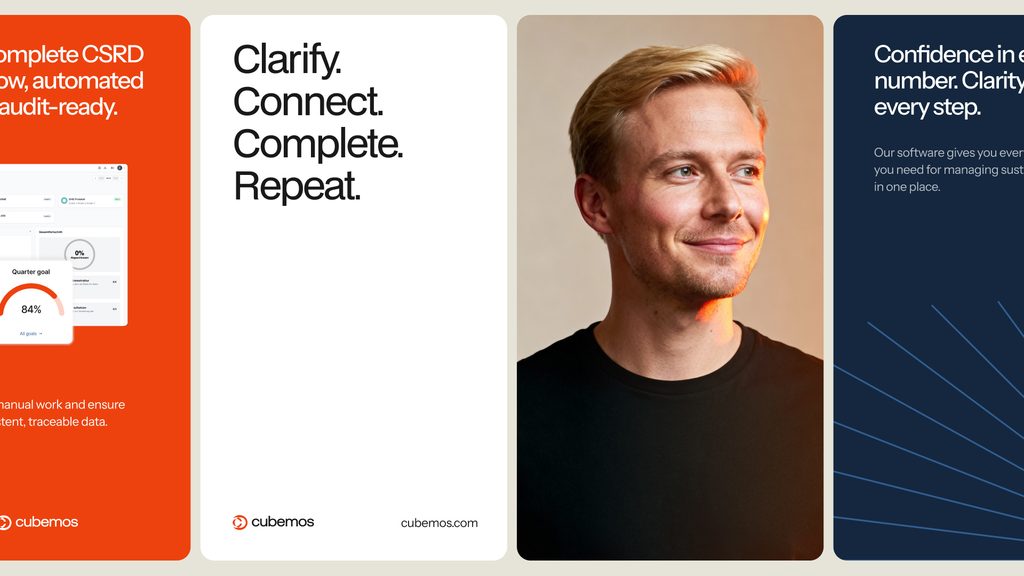
cubemos makes ESG reporting software, the kind that keeps big names like Ledvance and Breuninger audit-ready year after year. The product already brought order to a subject the whole category seems to enjoy making tangled. The brand just didn’t show it yet, so you only felt the clarity once someone walked you through a demo. We built everything around one idea, light as clarity inside complexity, and ran it through the strategy, the words, the photography, the site. We even named the main colour after it: Clarity Orange. Now the brand says what the product does at a glance, which is exactly what a stressed sustainability lead needs to feel before they’ll book a call.
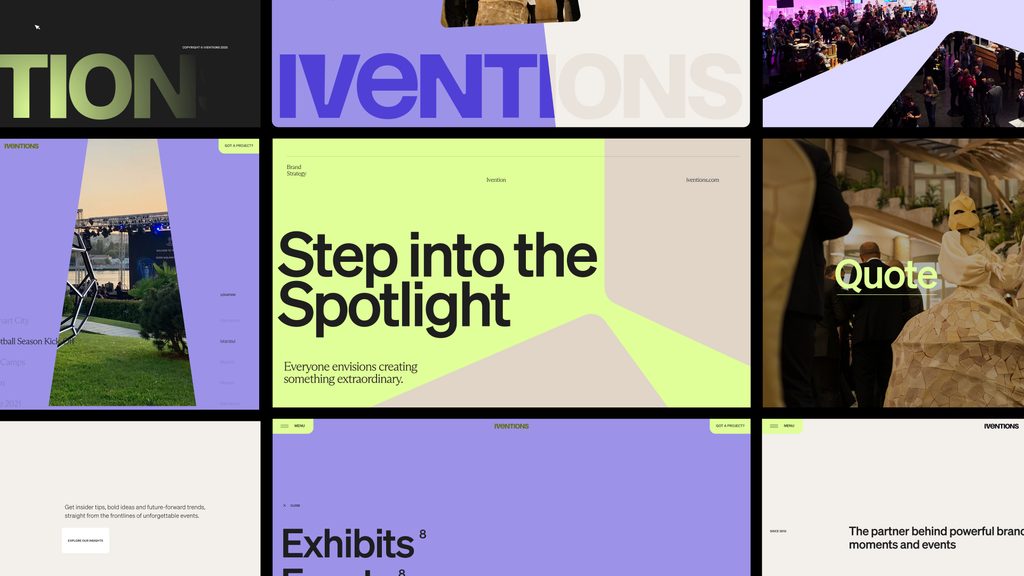
Iventions had pulled off 270-plus events across 31 countries with a 90% client return rate, and still had a brand hanging back in the wings while the work ran the show. In an industry where everyone says “seamless” and “extraordinary,” their real edge, a near-obsessive love of precision, just wasn’t landing. One line sorted it: “We perfect the details. You own the spotlight.” Suddenly the whole team was telling the same story, and the website became something they send before a meeting instead of something they explain away after. The design awards came calling soon after, which is a fancy way of saying the clarity shows.
Rudy Capital wanted to make crypto investing make sense to actual humans, in a category that mostly runs on jargon and noise. The brand had to be the calm, clear one in a very loud room. So the whole identity leans into simplicity. Clean lines. Plain words. Nothing that assumes you already speak crypto. The clarity is the product promise and the brand promise, at the same time.

Different worlds, same move every time. The outside finally matches the inside, and the company stops paying to be misunderstood.
The thing underneath all of it
You can’t patch a confusion tax with a new logo or a sharper headline. The cost comes from the pieces disagreeing, so the only fix that works is getting them to agree.
That means one idea at the centre, strong enough to run the whole show: the strategy, the words, the look, the way the product feels to use. It’s why we keep strategy and design in the same room from the very first day, rather than handing the work down a line and hoping it survives the trip. When that one idea makes it all the way to your customer intact, the brand finally feels like itself wherever people meet it. And it starts doing the explaining for you. Which, as it happens, is worth real money. Brand-consistency research from Lucidpress (now Marq) ties a consistently presented brand to revenue gains somewhere in the 23 to 33% range.
If any of this hit a bit close to home, the next step is just finding out what it’s costing you. That’s the whole point of a Brand Masterplan: a short, no-strings chat with Sebastian about where your story’s leaking value, and what it’d take to make it clear. Book a Brand Masterplan.
And if you want the bigger picture on how we build brands for B2B tech scaleups, start with The Serious Branding Guide to B2B Tech Scaleups.